
In any unpleasant conversation or social interaction you will ever have, there is DRAMA. But—other than feeling bad—how do you identify when drama is occurring?
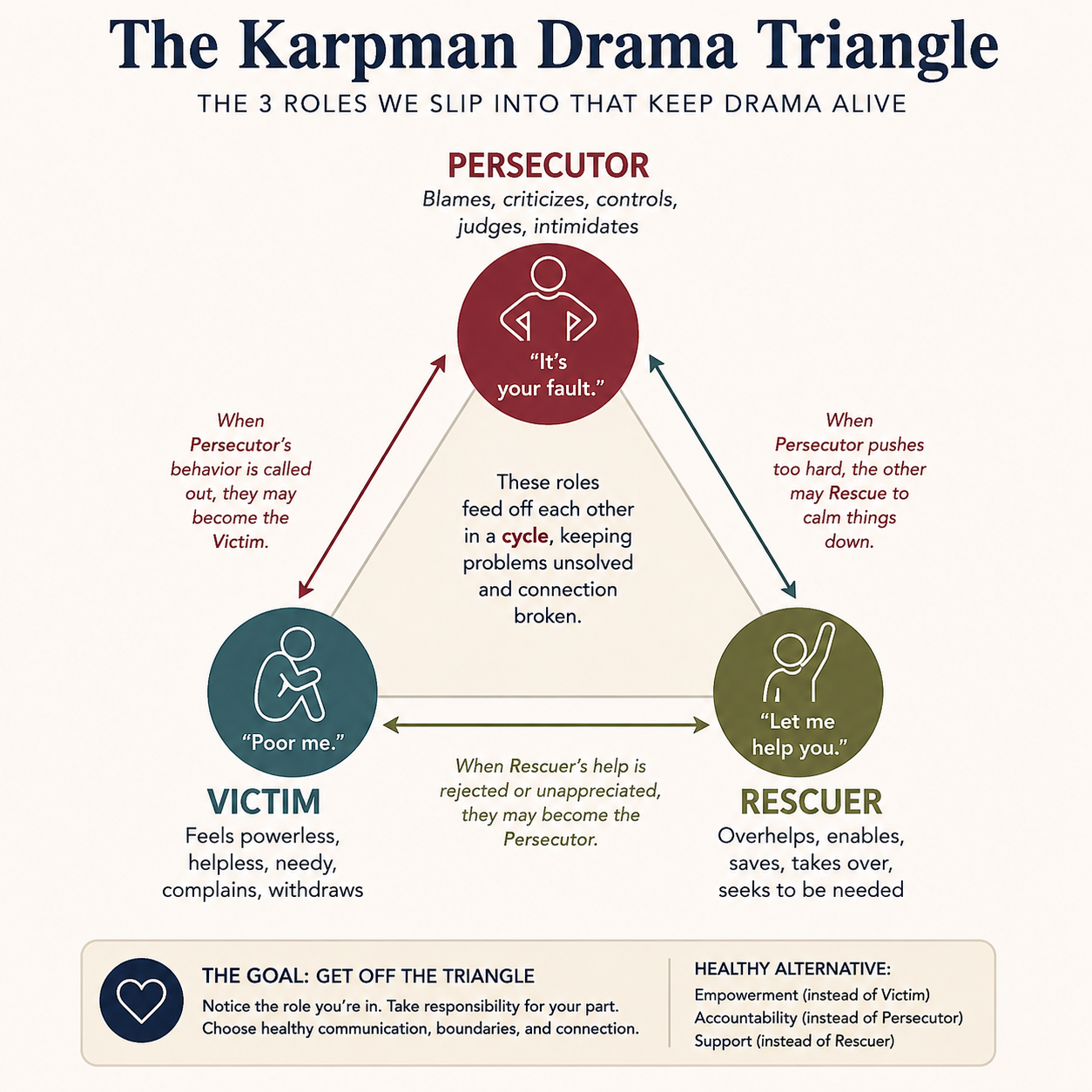
Drama involves at least three roles: a Victim, a Persecutor, and a Rescuer.
In the 1960s, Stephen Karpman created the “Drama Triangle” to help us better understand when we’re stepping into one of these three roles in social interactions and consciously choose to step out of them. If you can understand the Drama Triangle, you can gain insight into even your most difficult relationships and conversations. You can get practical tools that you can start using today.
So, here we go!
First: What Game Are You Playing?
The foundation of Transactional Analysis (the psychological theory at the core of the Drama Triangle) is that most of us have learned at some point that authenticity and intimacy are unsafe, so we learn to play games in social interactions to avoid authenticity and intimacy. We often think of “games” as being “fun,” but these types of games are usually incredibly UN-fun for at least one person, if not all involved. They are only “games” in the sense that they have predictable "pawns,” with predictable “moves” on the board, and a predictable “payoff” or result.
While most of us would claim to desire intimacy and authenticity, the reality is that most of us have limited tolerance for intimacy and authenticity and are on a continuous journey to increase that tolerance (which I believe is an excellent description of what Jesus called “the abundant life”…and also an excellent description of what I believe true therapy is all about).
Healing happens when we 1.) desire to step out of these games, 2.) learn how to step out of them, and 3.) consciously choose to step out of them. But to even begin to think of stepping out of games, you first have to recognize when they are happening.
There are many different types of games, but they all have some combination of these three roles: Victim, Persecutor, and Rescuer. This is where the Drama Triangle comes in.
Thanks for this great image, ChatGPT!
Just about every painful social interaction you have involves these three roles. They are custom-designed to keep drama alive. I’m willing to bet there are some people in your life who don’t even know how to interact in social situations without creating drama. It is their only script. It is all they know. In conversations that are especially confusing, the participants may be switching roles (for example, persecutor to victim and then back to persecutor) so lightning-quick that you find yourself feeling disoriented and exhausted.
Examples of Victim-Persecutor-Rescuer Dynamics
“Aren’t They Awful?”
The Drama
A Victim pulls in a Rescuer by telling them how awful the Persecutor is being. The “payoff” is that the Rescuer tells the Victim, “Oh, you poor thing! Let me help you.”
The thing is, the Victim doesn’t usually want help; they just want the Rescuer to feel angry and helpless along with them. After some frustrating attempts to comfort or cheer up the Victim, the Rescuer may then feel Victimized by the carried anger and helplessness they feel. Because these feelings are so unbearable, they perpetuate the cycle, becoming a new Victim and portraying the original person being gossiped about as a Persecutor, or even the person who spread the gossip as a Persecutor, to a new Rescuer…and round and round we go.
How to End the Drama
The Victim decides to take responsibility for their feelings by either confronting the original Persecutor or finding some other way to comfort themselves and let the offense go. Or, the would-be Rescuer says something like, “Wow, it sounds like you really have a problem with that person and are in a lot of pain. What would you like from me?” which encourages responsibility rather than taking on a Rescuer role.
“Look What You Made Me Do!”
The Drama
A Persecutor violates the boundaries of a Victim. When the Victim protests, the Persecutor then shifts roles, becoming the Victim and claiming that they were forced to act the way they did because of something the Victim said or did. The actual Victim, feeling very confused and disoriented, falsely believes they were the Persecutor, and so they flip to Rescuer mode. “How can I do better? How can I be a better partner to you to prevent you flying off the handle?”
After this cycle goes round and round a few times, the Victim feels so disoriented, angry, and afraid that they may actually become the Persecutor, yelling and throwing things at the original Persecutor, which just feeds their own false guilt and makes things really confusing when the police are called. The police end up calling it a “domestic disturbance” but not arresting anybody because by now it’s unclear who the original Persecutor was. The devastating “payoff” of this game is that the Victim loses identity, community, and a sense of reality; they think they’re the “crazy one,” and they end up coming to couples therapy for “communication problems.”
How to End the Drama
As anyone who’s been through it knows, this is a very difficult drama to end because it is so devastatingly confusing. Sometimes the Persecutor somehow leaves the picture. However, even if that happens, all too often the Victim ends up with another Persecutor. The Victim somehow must have enough outside support (often through a loving community and therapy) to honor their own truth. Then, they have to want to honor their truth. Unfortunately, many Victims have been so conditioned over a lifetime to believe that “this is just the price they must pay to be ‘loved’” and “this is all they deserve” that they don’t really want to end the game. It can often be a very long process for the Victim to 1.) acknowledge what’s happening, 2.) believe another way of life really is available to them, and 3.) safely exit the drama and begin stretching their legs in that new way of life.
“I Guess You Can’t Help Me”
The Drama
A Victim visits the doctor, ostensibly to get well. The Doctor/Healer takes on a Rescuer role, giving them prescriptions and advice for lifestyle changes. The Victim comes back in a few weeks after neither taking the medicine as prescribed nor changing their lifestyle. They sigh and tell the Doctor/Healer that it seems nothing ever works out for them. The Doctor/Healer gives them more prescriptions and more lifestyle advice, trying to figure out how to solve the Victim’s problem.
The Victim continues to not take the medicine as prescribed and not make the recommended lifestyle changes. By this point, they may be telling their friends they’ve tried going to the doctor and it seems they are just untreatable. The Rescuer Doctor is exasperated and feels helpless right along with the Victim. At this point, the game ends by either the Victim not going back to the doctor and perhaps repeating this same process with a different Rescuer Doctor, or the Doctor referring the Victim out, saying, “I don’t know what else to do.”
The payoff is that the Victim gets to remain in the Victim state, tells people “No one can help me,” and doesn’t have to do the work to heal. The Victim may then even choose to turn the would-be Rescuer Doctor into a Persecutor by telling others how unhelpful they were.
How to End the Drama
The Victim must somehow learn to take responsibility for their own life (which can be absolutely terrifying!), healing, and growth. The Doctor must refuse the Rescuer role and refuse exasperation and helplessness when the Victim does not take their medicine or change their lifestyle. The Doctor must not take responsibility, credit, or blame for their patient’s results, only for the appropriateness of the prescriptions and lifestyle advice they have offered.
But Why On Earth Would Anyone WANT to Stay in the Drama?
The above examples are so unpleasant, you may find yourself asking why on earth anyone would want to stay in the Drama Triangle. Because the payoff of each one of these "games” is that the drama continues.
We aren’t born acting this way. We learn it. And once we learn this script, we reenact it over and over as we go throughout our lives—until something disrupts it.
How did we learn that authenticity and intimacy were unsafe? How did we learn that drama, as painful as it is, was “safer” than being present, truthful, and free?
This is where the Three Ego States come in.
The Three Ego States
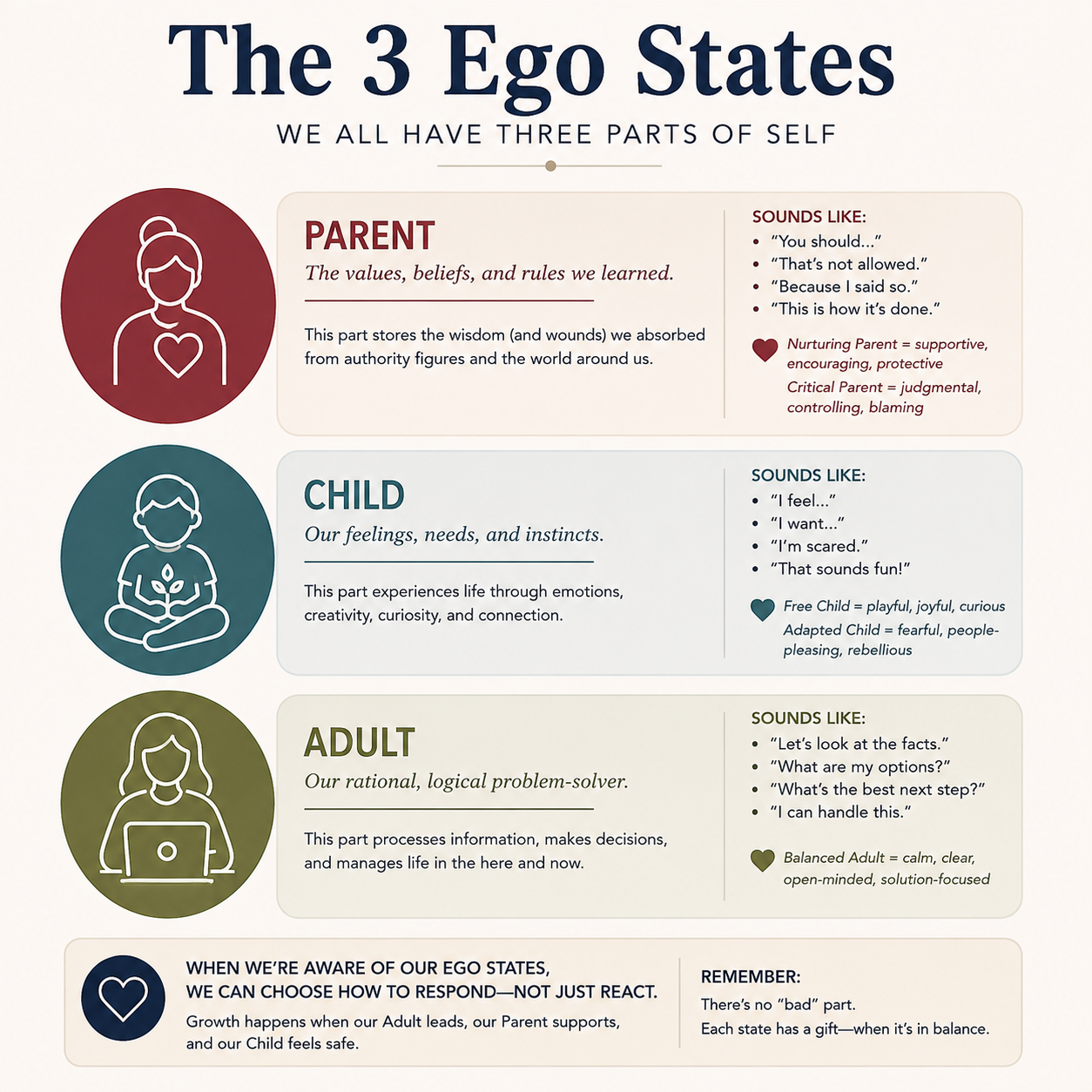
We all have three ego states: Parent, Child, and Adult. Each is valuable and needed but can be harmful and destructive if used inappropriately.
We were children…and, in some way, we are still children. It’s often our wounded inner child that brings us in to therapy. That part that’s still trying to earn Daddy’s approval, even after all these years. That part that still carries Mommy’s “never-good-enough” voice inside our head.
Because, like it or not, we also carry our parents with us, inside ourselves. Many of us begin therapy because we can’t get our parents’ voices out of our heads, even if we don’t always realize at first that it’s our internalized parents’ voices that are causing us so much pain. Often, the parts of us that cause the most pain are the very parts of us that are most like the parent we had the biggest problem with. A huge component of therapy is often the struggle to make peace with these parts—to not exile them or let them rule us.
And, of course, we are also adults. The goal of therapy is to lead from our wise Adult state, drawing on Parent and Child when appropriate but allowing neither to take over. The second one of those parts takes the lead, we’re back in the Drama Triangle.
Parent
The Parent Ego State is when we play a role similar to the role a parent played for us when we were a child. Being passive when we wanted to be assertive—like Mommy. Demanding that others change because we’re unable to look at ourselves and our own part—like Daddy.
Or, on the positive side of things…encouraging someone that they did their best and that’s all anyone can ask for, like Mommy. Or patiently teaching someone, step-by-step, how to fix something, like Daddy.
Nurturing Parent
How were you nurtured as a child? How were you encouraged? We tend to pass these behaviors on to others. This is the Nurturing Parent Ego State.
Taking on the role of the Nurturing Parent is loving and appropriate when a mother is comforting a child who just skinned their knee. However, it is not appropriate when a husband approaches his wife for sex in the same way that a child might approach Mommy asking for a hug after getting a booboo.
If the wife gives in because she feels that her husband “needs” sex in order to comfort him (even though he hasn’t been emotionally available, hasn’t been helping with the baby, has been angry and critical, etc.), she is not only taking on an inappropriate Nurturing Parent role; she is also taking on a Rescuer role. So one minute she’s treating her husband like a Victim; the next, she’s treating him like a Persecutor when she gets angry and resentful later about “always giving in to his needs for sex” while he never supports her needs with the baby. So now she feels like she has two babies to take care of, not just one.
And so the Drama begins.
Critical Parent
How did your parents discipline you? Was the punishment appropriate for what you did? Did they discipline you in a way that called you to your highest character or in a way that crushed your spirit? This is your Critical Parent Ego State.
Here are the ways this ego state often operates:
A parent telling a child they’re worthless when they get bad grades, don’t do well in sports, or otherwise don’t meet expectations
An abusive boss making snide remarks about an employee’s competence or cursing at them about how stupid they are
An abusive spouse accusing the other of cheating as a means of controlling their movement, when they don’t really have a good reason to be suspicious
Most of the time, when this ego state is operating, you are playing the role of the Persecutor.
Can this ego state ever be helpful? Yes! It’s helpful when your “Inner Critic” becomes your “Inner Coach,” saying things like, “Hey, I know you want to go out drinking with your friends, but your marriage is in jeopardy if you continue leaving your wife with all the chores and the baby at night after also leaving them with her all day. Now go home and help her out.” Your Critical Parent state can help protect others when their boundaries are being violated—for example, telling someone when their jokes are unacceptable and making others around them uncomfortable.
Child
The Child Ego State is not just being “childish” or “childlike”—it’s when we play a role similar to the role we specifically played as a child.
Natural Child
When you felt free, relaxed, joyful, and spontaneous as a child, what were you like? When you could run and play, with no worries or cares? This is your Natural Child Ego State. I believe this was the state of humanity in the Garden of Eden. In a world where toddlers couldn’t run into the street and be hit by cars, where we wouldn’t ever get bitten if we put our fingers in a dog’s face, and where everyone would do everything right so we wouldn’t ever be yelled at or get in trouble, we would all exist in the Natural Child Ego State. But, as we know, this is not the way the world is.
The Natural Child Ego State can be wonderful when a beloved child is playing in a park, guarded and guided by a nurturing mother. It can be wonderful when loving spouses are having sex and “frolicking and playing” in that way, enjoying their Natural Child Ego States together.
It can be destructive when one spouse is perpetually in a Natural Child Ego State while the other spouse takes on the lion’s share of the emotional and/or physical burden of running the house and parenting the kids, operating in Nurturing and Critical Parent Ego States all by themselves. It can be destructive when someone daydreams at their desk and plays ping pong with their coworkers while their supervisor’s deadline is long forgotten. In these cases, the person in the Natural Child Ego State steps into the role of Persecutor, nudging their spouse or boss into either a Victim or Rescuer role.
Adapted Child
Your Adapted Child Ego State is who you learned to be in the moments you discovered your Natural Child Ego State wasn’t welcome or wasn’t appropriate for the situation at hand. Its purpose is to maintain connection with a caregiver. Our Adapted Child Ego State all too often operates out of shame.
Some forms of the Adapted Child Ego State are mistaken for the Adult ego state (which we’ll get into below) and are actually rewarded by our culture. Many of us (without good therapy) spend a lot of time in this ego state!
Here are some examples where the Adapted Child Ego State can be appropriate:
A child learns that, in order to get out of diapers and wear big kid pants, they must control when and where they go to the bathroom. They gain the ability to “hold it” and raise their hand to ask the teacher to go to the bathroom.
You’re late, and it’s really tempting to run that red light. But you’re afraid of the cops and potential consequences, so you choose to be late rather than risk your and others’ safety.
A child is stuck in an abusive situation they can’t escape, yet this same abusive person is the one who provides them with love (at times), food, and shelter. Their Adapted Child Ego State learns to dissociate and disconnect from reality so at least part of them can be protected in the abusive moments.
Here’s where it’s not so helpful:
A little boy learns that when he cries, no one will come—and if they do, it will be Dad, and he will whip him. But he learns that if he is there for Mommy when she’s sad, he might get a hug. So he loses touch with his own emotions and becomes Mommy’s surrogate husband. Later, he often takes on the Rescuer role for his wife and burns himself out being the “fix-it” guy at work.
Every time a child does something they want to do, they get in trouble. But even when they try to obey the rules, their parent remains in Critical Parent mode, pointing out their flaws. They learn they “can’t ever do anything right, so why try?” So the child ends up doing drugs and dropping out of school later down the road. Later, they play either the Victim or Persecutor role in most of their relationships.
A little girl grows up learning that pretty, quiet little girls are the favorites. She learns to people please, never rock the boat, and hide her true self to gain approval. She ends up in a marriage with a man who has no interest in her internal world and constantly criticizes her appearance. She may often take a Victim or Rescuer role in the Drama Triangle—but on the outside, they look like the perfect family that has it all together.
That same child who dissociated in an abusive situation they couldn’t escape still dissociates as an adult, leaving them stuck in abusive relationships. This ego state falsely believes it needs to take over when, in reality, that child is now an adult who could get out and choose different relationships. This person may take a Victim role in the Drama Triangle.
Adult
This is the ego state we remain in most of the time when we are in health. This ego state fosters “same-same,” “I’m OK, you’re OK” interactions. The Adult Ego State says, “I can handle this, and I believe you can handle this.” I take responsibility for myself and my needs, and I trust you to do the same.
The Adult Ego State is the same as the True Self. It is the state of autonomy and awareness. We always want to lead from this state, even when we’re letting our Natural Child come out to play while throwing a football with our son or tackle-cuddling our spouse, or when a spike of fear leads our Adapted Child to stop at that stoplight or stay late at work rather than going to Happy Hour. Whether we’re letting our inner Nurturing Parent comfort our toddler who just got a boo-boo, or we’re briefly letting our Critical Parent come out in a moment of crisis. When our Adult Ego State stops leading, that’s when we enter the Drama Triangle.
Examples of Adult Ego State interactions:
Spouse 1: “When you said that, I thought I wasn’t valuable to you, and I felt hurt. I need you to speak more gently to me in the future.” Spouse 2: “I understand how you thought and felt that way, and I do not want you to feel that way. What’s some better language I can use in the future to bring up this type of concern while still letting you know how much I value you?”
Friend 1: “Thank you for listening. My boss’s actions really bother me, and I think I’m going to apply for another job.” Friend 2: “Absolutely! I believe in you, and I’m glad you’re caring for yourself by looking at other opportunities.”
When we come to therapy, the core question we need to answer is often “How do I consistently, consciously move out of Parent or Child Ego State to Adult Ego State?”
ChatGPT knocked it out of the park again.
How Ego States Create Drama
Drama is created when people step out of equal interactions into above-beneath interactions. For example, when one person approaches someone as one adult to another, but the person responds from Child Ego State, pressing the other into a Parent Ego State. Below is an example of an Adult-Adult conversation, followed by the same dialogue with drama injected into it:
“Could You Mop?” (Adult-Adult)
Husband (Adult): “Could you mop when you get a chance?”
Wife (Adult): “Sure, I’ll do that Saturday morning—could you mow the lawn while I’m doing that?”
Husband (Adult): “Will do.”
Snore…no drama here…boooorrriiiiinnnggg. And in this case, boring is awesome.
“Could You Mop?” (Parent-Child)
Husband (Adult): “Could you mop when you get a chance?”
Wife (Critical Parent): “Ugh…I wouldn’t have to mop so much if you would just take your muddy boots off at the door like I told you to!”
Husband (switches to Adapted Child): “I can’t ever do anything right! You’re always nagging! I work so hard to provide for our family, but it’s never enough!”
Now things are getting spicy…. The wife has become the Persecutor and the husband has become the Victim. Things probably escalate from here, old wounds are brought up, and we’re in the familiar, unpleasant dance that we’ve been doing in our marriage for 20 years.
Interrupting the Drama
Once the Drama Triangle has gotten started, one person has to shift their ego state to interrupt it. The good news? It just takes one of you! You don’t both have to be on your “A” game, and you don’t both have to understand what’s happening. Let’s say you’ve already entered Parent-Child in the “Could You Mop?” example. Here are two ways you could interrupt it:
Standard: Shifting Back to Adult-Adult
Wife (switching back to Adult from Critical Parent): “I so appreciate everything you do for our family. I do not want you to feel that you’re not doing anything right or that I’m constantly nagging you. How can we come up with a solution that works for both of us?”
Husband (switching back to Adult from Adapted Child): “Thanks, it means a lot to hear you say that. I’m going to make a sign and hang it up outside the door to remind myself to take my muddy boots off. I can imagine how frustrating it would be to have me walk all over the floor when you’ve just mopped it.”
Wife: “Thanks, I really appreciate you doing that. I’ll be glad to mop tomorrow.”
Playful/Experimental: Meeting in Child Ego State
Wife (switches to rebellious Adapted Child, speaking in child’s voice): “But I don’t wanna mop! You can’t make me!” pouts
Husband (switches to Natural Child, speaks in childlike voice): “We can mop together? While dancing? And you get to listen to my incredibly bad karaoke as I hold the handle like a microphone?”
Wife (switches to playful Natural Child): “Yeah baby…I’ll do the sexiest mop dance you’ve ever seen.”
Husband: “Ummm, can we ‘mop’ now?”
The goal is to realign the interaction—so you’re on the same page, not at odds. Whether you do the standard shift back to Adult or whether you do something more playful like meeting them in Child probably depends on your general level of comfort, trust, and safety with the person. The more interactions you have in which you either avoid the Drama Triangle altogether or quickly snap out of it once it begins, the more playful and relaxed you’ll be when above-beneath interactions occur (and trust me, they will never stop occurring)! Your brain and body will feel safer with the person, and that safety will create a greater sense of fun in your relationship.
Where It Gets Messy: When the Real Ego State Isn’t What It Appears on the Surface
This is where it gets really ugly and really confusing. There is a type of interaction in which, on the surface, someone is interacting from Adult to Adult. However, underneath, they are interacting in a Parent-Child or Child-Parent way. Here are some examples:
“I Couldn’t Possibly Find the Time”
Pickleball Player 1: “Thanks for asking about the tournament. My partner and I actually won!”
Pickleball Player 2: “You’ve gotten so good at this! Between taking my kids to national competitions, my new promotion at work, and being the president of the PTA, I couldn’t possibly find the time to practice as much as you do.” (Adult-Adult on the surface, but underneath Parent-Child, implying that this person is more important, busy, hardworking, and/or valuable than the person they are talking to, subtly shaming them for taking so much time for their hobby)
“I Know I Forgot”
Husband: “I know I forgot to take out the trash again.”
Wife: “Don’t worry about it, I’ll just do it.”
On the surface, this is Adult-Adult communication. But underneath, it’s a “Natural Child” to “Critical Parent” interaction. And when one spouse takes on a “Critical Parent” role, the other one knows deep down that there will probably be bitterness and resentment later. Everyone eventually loses with this type of interaction.
“Give Me the Remote”
Husband: “Honey, could you set that show to record when it comes on?”
Wife: “Sure, just give me a second to figure out the buttons.”
Husband: “Oh, just give me the remote.”
On the surface, the husband is just asking for the remote and offering to help. Underneath the surface, the husband is treating the wife like a child who couldn’t possibly figure out the remote. He is taking on a parent role to fix it for her, which may cement the idea in his mind that his wife just isn’t as competent as he is.
Moving Away from Drama toward Authenticity & Intimacy
If you’ve made it this far, you probably have a few people in mind.
Maybe you’re thinking about the coworker who somehow turns every conversation into a crisis. The family member who always seems to need rescuing. The spouse who can turn a simple request into a three-hour argument. Or maybe—and this is usually the more uncomfortable question—you’re recognizing yourself in some of these examples.
Good.
Not because there’s something wrong with you, but because awareness is the beginning of freedom.
The goal of understanding the Drama Triangle isn’t to become really good at identifying who the Victim, Persecutor, and Rescuer are. In fact, if you walk away from this article thinking, “Aha! She’s the Victim and he’s the Persecutor,” you may have missed the point entirely.
The question is not, “Who is the bad guy?”
The question is, “What role am I playing right now, and what would it look like to step out of it?”
Am I trying to control someone because I’m afraid?
Am I handing responsibility for my life to someone else because I feel helpless?
Am I taking responsibility for someone else’s emotions, choices, or consequences because I’m afraid of what will happen if I don’t?
And underneath all of that:
What part of me is running the show right now?
Is my Critical Parent demanding, judging, or controlling?
Is my Adapted Child afraid, ashamed, people-pleasing, or rebelling?
Is my Nurturing Parent frantically trying to make everyone okay (possibly so I can finally feel okay)?
Is my Natural Child desperately trying to escape responsibility?
Or is my Wise Adult present?
The Adult says:
I am responsible for me.
You are responsible for you.
I can tell you the truth without controlling you.
You can tell me the truth without destroying me.
I can have needs without making them your responsibility.
You can have needs without making them my responsibility.
I can care about you without rescuing you.
I can hold a boundary without persecuting you.
And I can tolerate your disappointment without immediately trying to make it go away.
That is what healthy relationships look like.
Instead of Victim:
“There’s nothing I can do.”
We move toward:
“This is painful, and I need to decide what I’m going to do about it.”
Instead of Persecutor:
“You need to change.”
We move toward:
“This behavior doesn’t work for me, so here is what I am going to do to care for myself.”
Instead of Rescuer:
“Let me fix this for you.”
We move toward:
“I believe you are capable of handling this. How can I support you?”
Stepping out of the Drama Triangle is ultimately an act of love.
Love tells the truth without cruelty.
Love offers help without taking over.
Love receives help without surrendering responsibility.
Love sets boundaries without needing to punish.
Love allows other people to experience the natural consequences of their choices.
Love refuses to make another person responsible for your emotional world—and refuses to take responsibility for theirs.
And, perhaps most importantly, love trusts that the other person is capable of being an adult, too.
That can feel terrifying if you learned early in life that relationships only work when you are performing a particular role. Maybe you learned that being lovable meant rescuing people. Maybe it meant never having needs. Maybe it meant keeping everyone happy. Maybe it meant being in control. Maybe it meant being the good girl, the strong one, the fixer, the achiever, the peacekeeper, or the one who never caused trouble.
Those strategies probably made sense once.
They may even have helped you survive.
But you don't have to keep playing the same game just because it was the only game you knew how to play.
You can learn a new way.
All it takes is one person to change the game.
So the next time you find yourself in the middle of a conversation that suddenly feels weirdly familiar—pause.
Ask yourself:
What game are we playing?
What role am I playing?
What ego state am I in?
And what would it look like to step out?
You don't have to fix the other person.
You don't even have to get them to understand what you're doing.
You just have to step out of the triangle yourself.
Sometimes, that's all it takes to change the entire conversation. And, eventually, your entire relationship.
